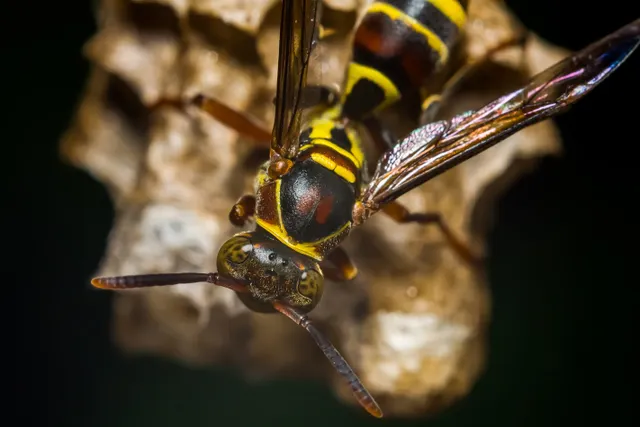
A nest near a door, play area, roofline, or wall can make ordinary movement around a property difficult. Wasp and hornet control begins by locating activity without provoking it, identifying the likely type of stinging insect, and choosing a response that fits the nest location and access.
Signs of a Nest
Repeated flight in and out of a gap, steady traffic around an eave or soffit, insects entering a wall, or a paper nest under a deck or overhang can indicate a nest. Yellow jackets may also use ground openings or concealed voids. A few insects around a flower or drink do not identify a nest, and the safest way to assess a suspected nest is from a distance. Species, nest location, time of year, and the amount of activity all affect the next step.
Examples in Ohio
- German yellowjacket — OSU Extension identifies it as Ohio’s dominant yellowjacket; the fact sheet notes yellowjackets shift toward sweets in late summer. OSU Extension · Yellowjackets
- Bald-faced hornet — An open-air nest is a useful clue: OSU Extension says exposed nests are usually built by bald-faced or yellow hornets. OSU Extension · Yellowjackets
- Eastern cicada killer — A large, solitary wasp, unlike a worker-filled social nest. OSU Extension · Cicada Killer Wasp
Educational clues only; the page photograph does not identify a species.
Assessment and Scope
The assessment considers whether the insects are using an exposed nest, a wall or roof void, or a ground opening; how close the activity is to people and pets; access, height, and the condition of the structure; and whether more than one nest is involved. We also ask whether anyone has already sprayed, blocked an opening, or removed part of a nest. A concealed nest should not be opened or sealed without understanding what is inside and where insects are traveling.
Potential Treatment and Cost Factors
Depending on the findings, a service visit may include a labeled, targeted application and removal of an accessible nest when appropriate. A void or elevated nest may require a different plan, additional access, or referral when the requested work is outside the available scope. Results and timing vary with species and location, and removing a visible paper nest does not necessarily address a hidden nest. Cost factors include species, nest size and number, height, access, wall or roof construction, distance from occupied areas, and whether a return visit or repair coordination is needed.
Do not spray, knock down, burn, block, or otherwise disturb a suspected nest yourself. Keep children and pets away, use another entrance when possible, and do not seal a flight opening while insects may still be inside. After activity is addressed, inspect eaves and screens, keep food and sweet drinks covered outdoors, and repair gaps only when it is appropriate to do so.
Related Services
For other recurring insects around a home, start with residential pest control. Webs or insects gathering around exterior lights may also be relevant to spider control. Businesses and property managers can review commercial pest management for a site-specific plan.
When to Request Help
Request help when a nest is near a regularly used entrance, inside a wall or roof void, above a deck, or in an area that cannot be avoided. Tell us the nest location, visible activity, height, and any prior disturbance, and keep people away until it can be assessed.